Bloodstained Edelweiss
The 1st Mountain Division in the Second World War
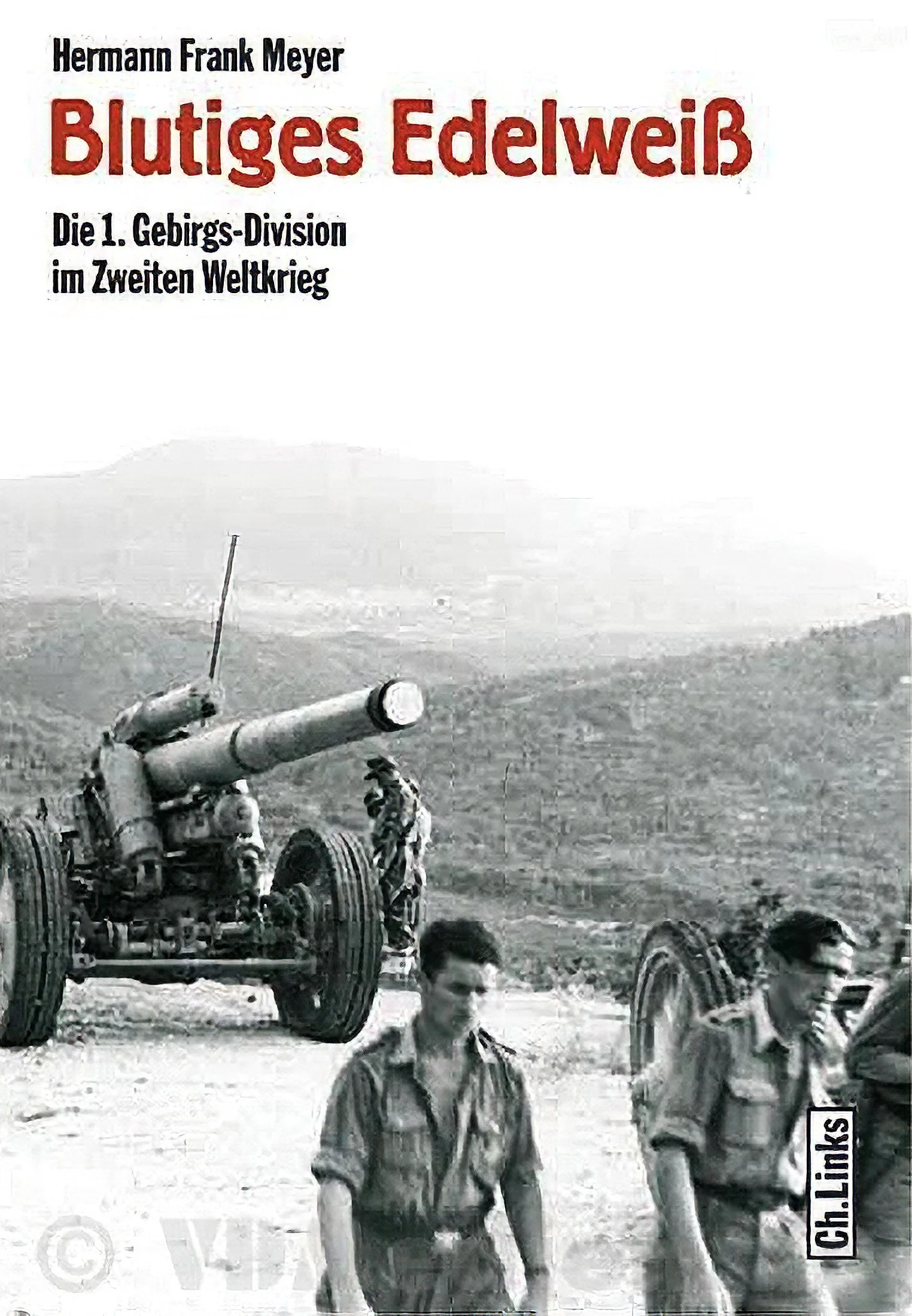
Αιματοβαμμένο Εντελβάις
Η 1η Ορεινή Μεραρχία, το 22ο Ορεινό Σώμα Στρατού και η εγκληματική δράση τους στην Ελλάδα, 1943–1944
2 volumes
Βιβλιοπωλείον της Εστίας, 2009
Il massacro di Cefalonia
La 1ª divisione da montagna tedesca
Gaspari Editore, 2013
Blutiges Edelweiss
Die 1. Gebirgs-Division im Zweiten Weltkrieg
Ch. Links Verlag, 2008
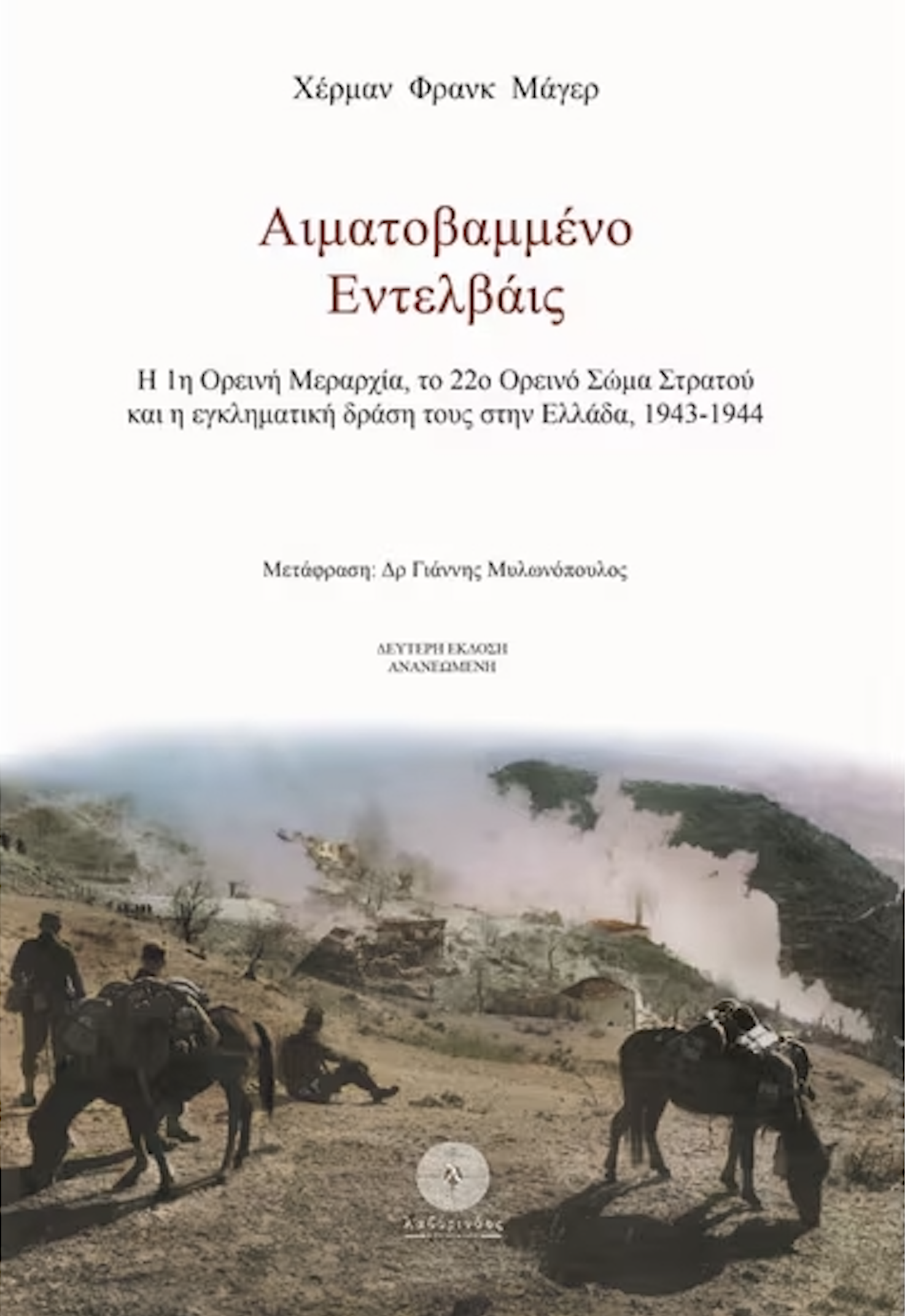
Αιματοβαμμένο Εντελβάις
Η 1η Ορεινή Μεραρχία, το 22ο Ορεινό Σώμα Στρατού και η εγκληματική
δράση τους στην Ελλάδα, 1943–1944
Βιβλιοπωλείο Λαβύρινθος, 2024
The Edelweiss – worn on the cap and sleeve – was the insignia of the 1st Mountain Division of the Wehrmacht, an elite troop re-established in the German Federal Armed Forces (Bundeswehr) eleven years after the end of the war under the same name by former leaders of the Wehrmacht. In these circles and in a post-war Comrades Association of the Mountain Troops (“Kameradenkreis der Gebirgstruppe”) the Edelweiss is regarded even now as a symbol of the “best German military tradition in war and peace”. In honouring this tradition, however, no one speaks about the war crimes committed in the Second World War. How did they come about, who gave the criminal orders, who followed them, why were such inhuman actions carried out? And how was it possible that after the war every single attempt to hold inquiries or even preliminary proceedings were flatly and scandalously turned down so that the perpetrators were never called to account? These are the fundamental questions that the author has raised and tried to answer.
The author has researched not only the judicial proceedings held in Germany, Greece and Italy, the “South East General Trial” (Suedostgeneralprozess CaseVII), submitted to the American war trials in Nuremberg, but he has also studied all the relevant documents of the Wehrmacht. He went through documented memoirs of former mountain soldiers, he evaluated their private notes or diaries and he analyzed documents by military experts and historians writing after the war about the 1st Mountain-Division, published in Germany, Italy, Greece and the United Kingdom. His research led him to travel to ten countries and to consult more than two dozen archives. In Greece and in Albania he visited more than two hundred villages to see the real locations and to question contemporary witnesses. He was often the first German there since the Second World War. Although more than sixty years after the events, the villagers have not forgotten those atrocities.
In his introduction, the author describes the creation of the 1st Mountain Division by the National Socialists and outlines the career of Herbert Lanz, General of the Mountain Troops, who was in charge of the Division fighting the Eastern campaign and who was later promoted to command the XXIInd Mountain-Army-Corps. He then describes the actions in the campaigns against Poland, France, Yugoslavia and the war of extermination against the Soviet Union (“The 1st Mountain Division in combat from September 1939 to March 1943”).
Having sustained very heavy losses in its push into the Caucasus, the Division was transferred to the Balkans for some “freshening up” where the men were then involved in a major operation against the partisans in Montenegro(“Operation Black: Action against partisans in Montenegro, May/July 1943”).
As the Axis powers expected an Allied invasion in South East Europe, the Division was then transferred to Greece and South Albania. Although there were only a few sporadic skirmishes with the Greek and Albanian partisans, the response was systematically to destroy the villages and to kill the inhabitants along the route of the advancing units (“The 1st Mountain Division in Thessaly, Epirus and South Albania”).
General Lanz had meanwhile been appointed commander of an Army Corps in the Charkow sector where he apparently disregarded Hitler’s directives (“Interlude: Hubert Lanz appointed by Hitler to command an Army Corps – January/February 1943”). He only held this command for a few weeks.
In July 1943 Lanz was given the task of creating the XXIInd Mountain-Army-Corps in Greece which would control the 1st Mountain Division and the 104th Jäger Division (“The new XXIInd Mountain-Army-Corps”). In this position, Lanz was responsible for disarming the Italian troops in Western Greece, the Ionian Islands and South Albania after the Italian capitulation in September 1943. The murdering of captured Italian soldiers and officers of the Division Acqui is one of the central themes of the book. On the basis of the number of victims, this is arguably one of the biggest massacres carried out by the Wehrmacht. Hundreds of books, treatises and articles have been written about it, but in a large majority of these publications, the writers have presented as facts their own assumptions and speculations about the events and the numbers of victims, so that false legends and myths have been created which the author exposes and corrects (“The disarmament of the Italian Army Corps, September-October 1943”).
After the Italian retreat, Lieutenant Colonel Josef Salminger, a popular regimental commander, died of his wounds after a partisan attack. As “atonement measure” Lanz ordered that civilians should be massacred and whole villages robbed and burned to the ground. The commander of the right-wing Greek resistance group EDES, Colonel Napoleon Zervas, under pressure from the Germans, agreed to a “moratorium”. The author has uncovered a vast amount of documentation that has not been published before concerning the controversial question as to whether this was an act of collaboration which in fact contributed to the outbreak of the Greek civil war that lasted until 1949 (“Partisan war in Epirus and the “Gentlemen’s Agreement” between Germans and the EDES”).
Once the EDES was seen to be holding back, the 1st Mountain Division left Greece in November 1943 and was deployed in Montenegro and Serbia against Tito’s partisans and then moved on to disarm the Hungarians in the spring of 1944. Subsequently, the Division returned to Epirus, Macedonia and South Albania where it fought in two major operations against the left-wing partisan bands (the ELAS and others) and inflicted serious losses on them. After another transfer back to Serbia and Hungary, the Division suffered its highest losses in the battles near Belgrade and lake Balaton. At the end of the war it was stationed in Austria.
Meanwhile, the XXIInd Mountain-Army-Corps continued in Epirus being in charge of a few Battalions and the 104th Jäger Division. The latter operated near Agrinio with collaborating Greek Security Battalions („Tagmata Asfaleias“) who had been enlisted to participate in shooting hostages and in combating left-wing ELAS partisans. Meanwhile, the EDES commander Zervas flipped between the Germans and the British liaison officers (BLO), his main aim being to seize power in Greece after the war. This was also the period when the Jewish population was deported from Western Greece and Corfu, with the XXIInd Mountain-Army-Corps having its hand in this operation. (“The 1st Mountain Division as ‘fire brigade’ in South East Europe, deportation of Jews and retreat, November-May 1945”).
The book ends with a chapter about the post-war careers of the former officers of the Division and the Corps in the 1st Mountain Division of the Bundeswehr (German Federal Army) and about the activities of the Comrades Association of the Mountain Troops (“Kameradenkreis der Gebirgstruppe”).
INDEX
VORWORT
EINLEITUNG
1. Die Entstehung der 1. Gebirgs-Division2. Hubert Lanz’ Werdegang zum Generalstabschef der Gebirgstruppe (Oktober 1914 – Februar 1940)
I.
DIE 1. GEBIRGS-DIVISION IN DEN KÄMPFEN VON SEPTEMBER 1939- MÄRZ 1943
1. Die „Sturmfahrt auf Lemberg“. Die Gebirgsjäger im Krieg gegen Polen (September 1939)2. Westfeldzug, Unternehmen „Felix“ und „Blumenkrieg“: Die Gebirgsjäger in Frankreich und Jugoslawien (Mai 1940-April 1941)3.Vorbereitung des Unternehmens „Barbarossa“ (Mai-Juni 1941) 4.Das Offiziersideal der Division: Josef Salminger und Harald von Hirschfeld 5.„Die erste Gebirgs-Division holt den Teufel aus der Hölle“ – Der Beginn des Feldzuges gegen die Sowjetunion
(21. und 22. Juni 1941) 6.Die Gebirgsjäger und das Juden-Pogrom von Lemberg (Juni 1941)7.Durch die Steppe zum Mius (Juli-Dezember 1941)8.Kämpfe im Raum Charkow (Frühjahr 1942)9.Das Unternehmen „Edelweiß“: Vorstoß in den Kaukasus (Juli-Dezember 1942)10.Bilanz und Führungswechsel (Dezember-Januar 1943)11.Rückzug auf den Kuban-Brückenkopf (Januar-März 1943)
II.
DAS UNTERNEHMEN „SCHWARZ“: EINSATZ GEGEN PARTISANEN IN MONTENEGRO (MAI/JUNI 1943)
III.
DIE 1. GEBIRGS-DIVISION IN THESSALIEN, EPIRUS UND SÜDALBANIEN
1. Die Entwicklung in Griechenland seit Einfall der Wehrmacht (April 1943-Februar 1943) 2. Die Folgen der britischen Unternehmen „Mincemeat“, „Animals“ und „Washing“ (April-Juni 1943)3.Die Situation in Epirus und Südalbanien: deutsche und italienische „Sühnebefehle“ (Sommer 1943)4.Der „Marsch nach Ioannina“: Partisanenkampf und Verbrechen - die Massaker in und um Borovë (6.–9. Juli 1943)5.Das Morden geht weiter: Kalovrisi, Mazi, Aetopetra, Aidonochori, Vasiliko, Kefalovriso, Zienë und Draçovë6.Das Unternehmen „Salminger“: „Säuberungen“ an der Straße Ioannina – Arta (22.-25. Juli 19437.Die Massaker von Mousiotitsa (25. Juli und 22. August 1943)8.Italienische „Säuberungsunternehmen“ an der Seite der Deutschen (18.-28. Juli 1943)9.Das Unternehmen „Augustus“: 250 ermordete Zivilisten und 20 niedergebrannte Dörfer10.Das Massaker in Kommeno11.Der Tag danach und die Aufarbeitung
IV.
ZWISCHENSPIEL: HUBERT LANZ ALS VON HITLER ERNANNTER
BEFEHLSHABER EINER ARMEE-ABTEILUNG (JANUAR/FEBRUAR 1943)1. Auseinandersetzungen um einen Führerbefehl2. Die Kämpfe um Charkow 3.Hubert Lanz – ein Widerstandskämpfer?
V.
DAS NEUE XXII. GEBIRGS-ARMEE-KORPS
1. Hubert Lanz’ Berufung zum Korps-Kommandeur und Folgen der Kapitulation Italiens (Juli-September 1943) 2. Die Bildung der 104. Jäger-Division und die Verlegung nach Griechenland (April-August 1943)
VI.
DIE ENTWAFFNUNG DER ITALIENISCHEN ARMEE-KORPS
(SEPTEMBER-OKTOBER 1943)
1. Stichwort „Reise“2. Auseinandersetzungen um die Entwaffnung der italienischen Division Acqui (10.-12. September 1943)3.Gescheiterte Enwaffnung der Italiener auf Korfu (13. September 1943) 4.General Gandin taktiert und widersetzt sich (13./14. September 1943)5.Der mißlungene deutsche Angriff auf Kefalonia (15.-18. September 1943)6.Hitlers Befehl zur Ermordung der Italiener auf Kefalonia7.Deutscher Vormarsch auf Kefalonia und erste Massaker (17.-20. September 1943)8.„Alles was vor die Mündung kommt, wird umgelegt“ – die Vernichtung der Italiener auf Kefalonia (21.–23. September 1943)“ 9.Die Hinrichtung General Gandins und die Massaker an der Casa Rossa (24. September 1943) 10.Das Schicksal der überlebenden italienischen Kriegsgefangenen auf Kefalonia (G107)11.Die Bergung der sterblichen Überreste der ermordeten Italiener auf Kefalonia (G110) 12.Verschleiert durch Spekulationen und Manipulationen – die Zahl der italienischen Opfer auf Kefalonia 13.Nachkriegsermittlungen14.Das Unternehmen „Verrat“ – die Niederschlagung der Italiener auf Korfu (23.-27. September 1943) 15.Das Unternehmen „Spaghetti“ – die Gefangennahme der italienischen Einheiten in Südalbanien (27. September – 7. Oktober 1943)
VII.
PARTISANENKRIEG IN EPIRUS UND DAS
„GENTLEMEN’S AGREEMENT“ ZWISCHEN DEUTSCHEN UND EDES
1. Die Geiselmorde in Paramythia (19. und 29. September 1943) und deren juristische Verarbeitung nach 1945 2. EDES-Aktivitäten, Josef Salmingers Tod und das Massaker in Lyngiadis am 3. Oktober 19433.Die Mission des IKRK-Delegierten Hans-Jakob Bickel: humanitäre Hilfe und Vermittlung zwischen Deutschen und EDES (September/Oktober 1943)4.Napoleon Zervas’ Werdegang zum EDES-Kommandeur und Sondierungen mit General Lanz 5.„Säuberungsunternehmen“ gegen ELAS-Andarten und der Abzug der 1. Gebirgs- Division aus Griechenland (Oktober/November 1943)6.Deutsche und EDES gemeinsam gegen die ELAS: das Unternehmen „Sperber“ und ein „Gentlemen’s Agreement“
VIII.
DIE 1. GEBIRGS-DIVISION ALS „FEUERWEHR“ IN SÜDOSTEUROPA,
JUDENDEPORTATIONEN UND RÜCKZUG (NOVEMBER 1944 – MAI 1945)
1. Der Einsatz gegen Tito-Partisanen (November 1943-Februar 1944) und in Ungarn (März-Mai 1944)2. Die Unternehmen „Gamsbock“ und „Steinadler“: Kampf gegen Partisanen in Südalbanien und Mazedonien (Mai-Juli 1944) 3.Die Deportation der jüdischen Bevölkerung aus dem Befehlsbereich des XXII. Gebirgs-Armee-Korps (März 1944 bis Juni 1944) 4.Zusammenarbeit mit griechischen Sicherheitsbataillonen bei den Geiselerschießungen in Agrinio (14. April und 31. Juli 1944) 5.EDES-Führer Zervas zwischen Deutschen und Briten (Mai 1944 - August 1944)6.Der Rückzug des XXII. Gebirgs-Armee-Korps aus Epirus und Aitoloakarnania (September/Oktober 1944) und Fazit der deutschen Besatzung 7.Verlustreiche Kämpfe auf dem Balkan und das Ende
IX.
NACHKRIEGSKARRIEREN UND DIE 1. GEBIRGS-DIVISION ALS TEIL DER BUNDESWEHR
1. Die Nachkriegszeit
ANHANG
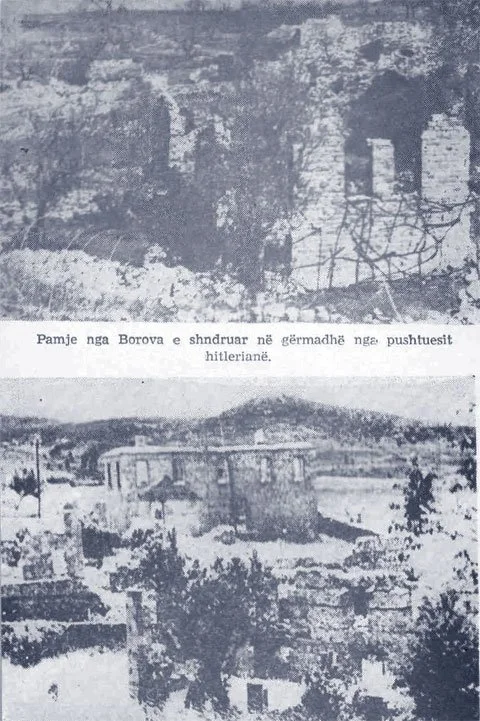
In reprisal for a partisan attack in which no German soldier was killed, more than 100 civilians were murdered in Borovë, Albania, and the village was burned to the ground in July 1943.
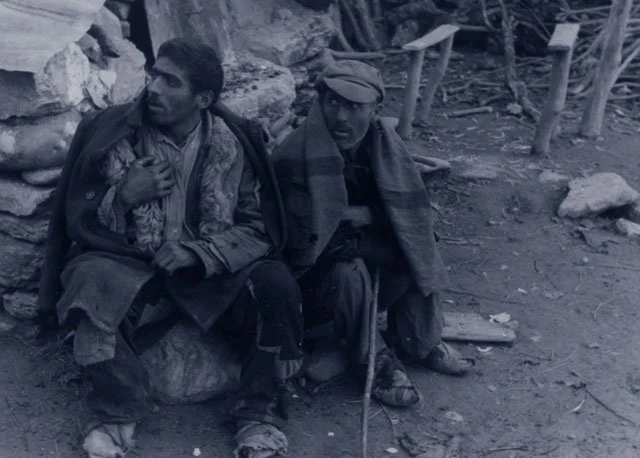
Suspected partisans before their execution, 1943.
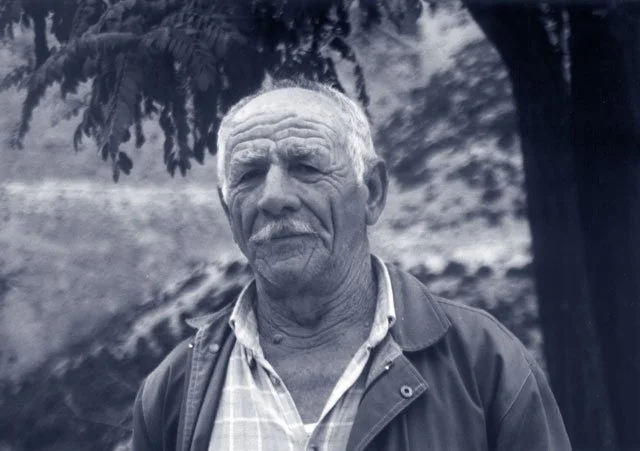
Giannis Gokas from Mousiotitsa survived the execution of 77 women and children by hiding beneath his mother's skirt, July 1943.
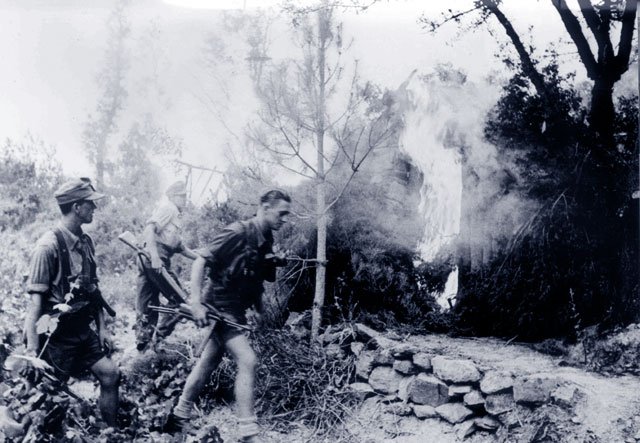
Mountain troops setting fire to homes, summer 1943.
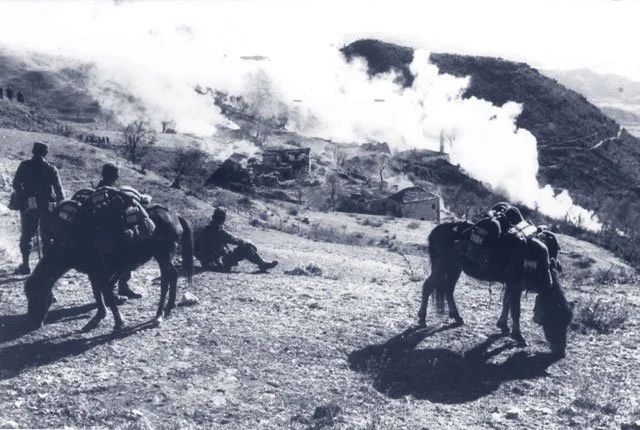
A village engulfed in flames, 1943.
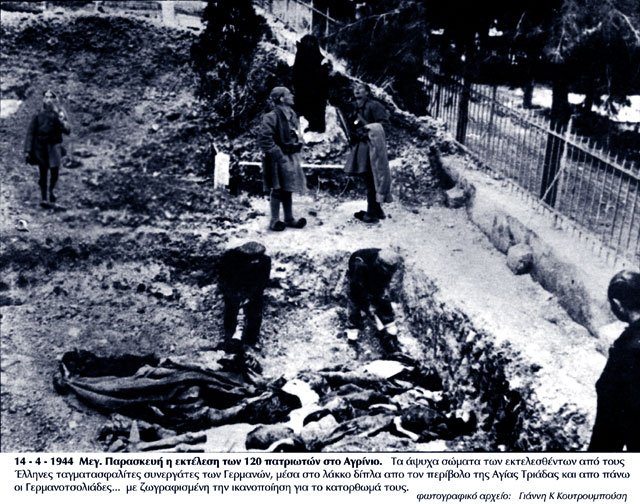
Hostage executions in Agrinio, Greece, March 1944.
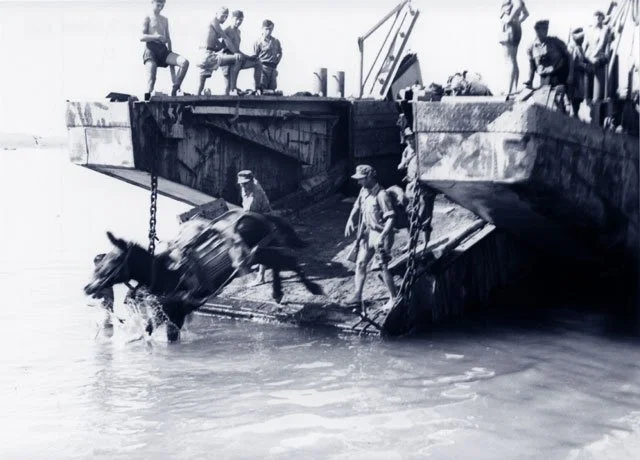
Before the occupation of the island of Corfu, October 1943.
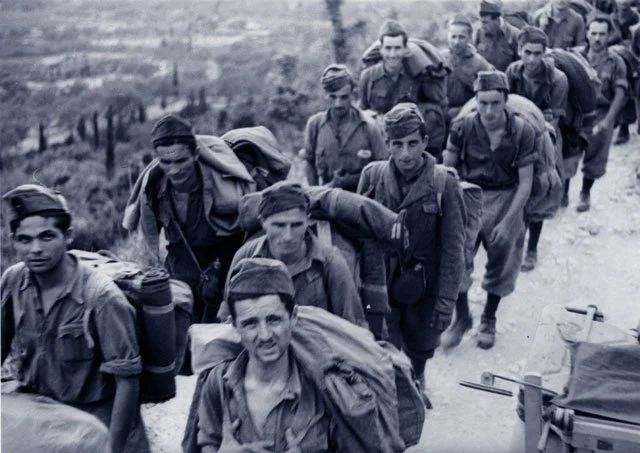
Italian soldiers on their way into captivity, October 1943.
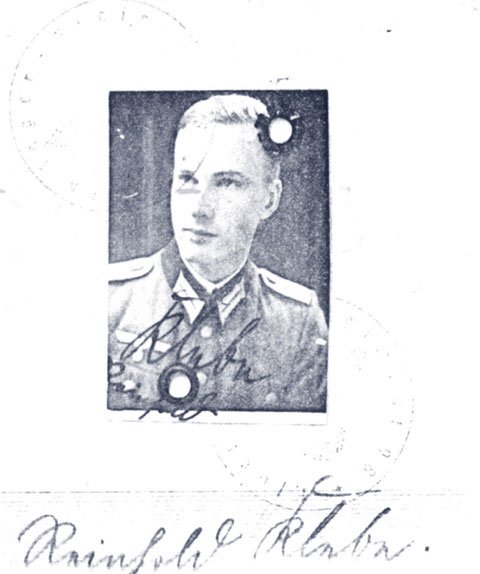
Major Reinhold Klebe, commander of III./98, was responsible for the massacres of around 500 civilians in Mousiotitsa and Kommeno, and of hundreds of Italian prisoners on Kefalonia, July–September 1943.
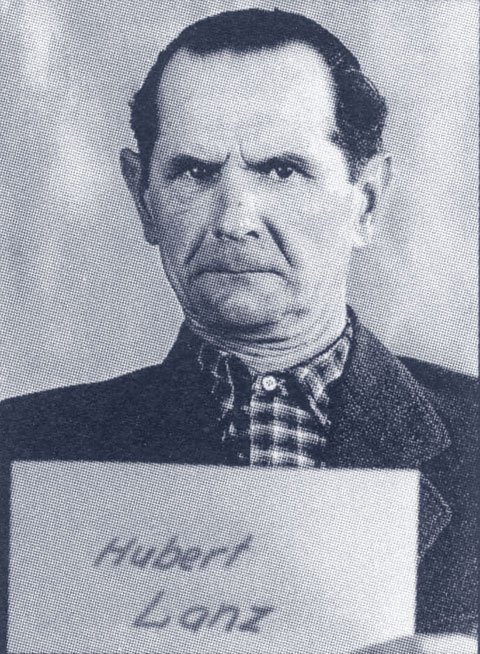
Hubert Lanz was sentenced to 12 years' imprisonment at the Hostages Trial in Nuremberg, 1948.
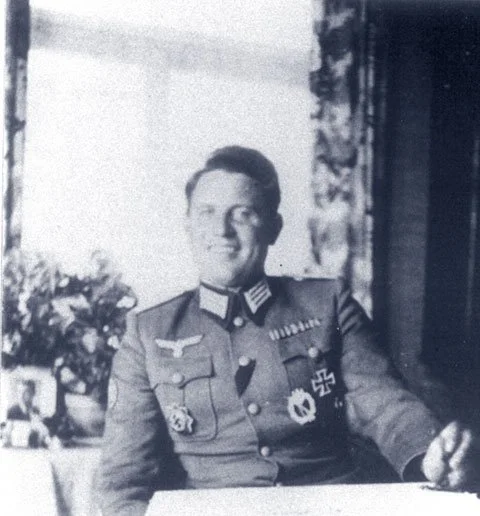
First Lieutenant Willi Röser, 12./98, bore responsibility for the murder of 317 civilians in Kommeno on 17 August 1943.
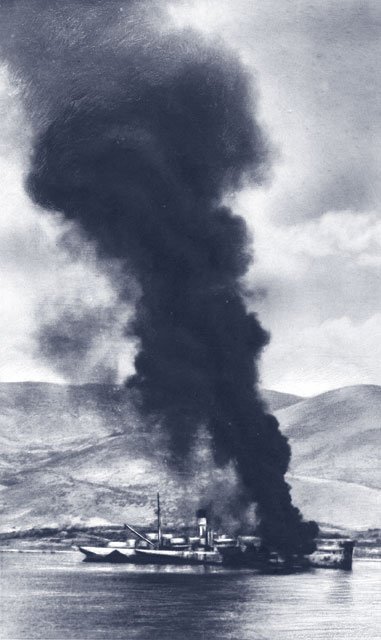
After the murder of more than 2,000 Italian prisoners, hundreds more drowned in ship sinkings, autumn 1943.
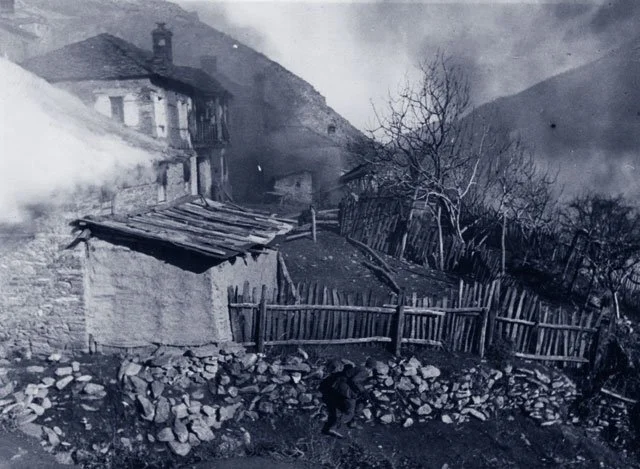
In Epirus alone, more than 300 villages were burned to the ground between July and October 1943.
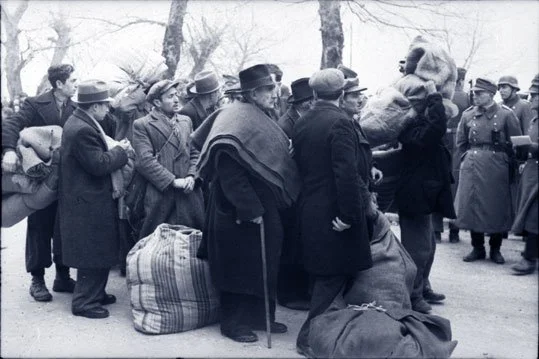
About 2,000 Jews from Ioannina were deported to Auschwitz from the area under the command of the XXII Mountain Army Corps, March 1943.
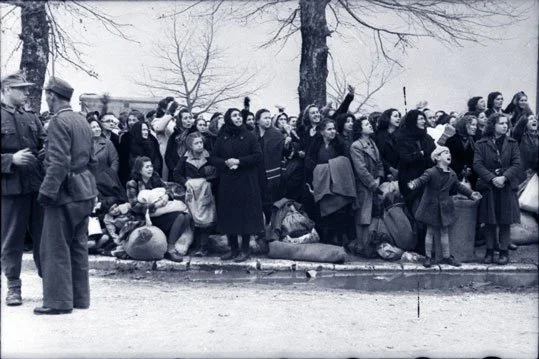
2,000 Jews from Ioannina were deported to Auschwitz from the area under the command of the XXII Mountain Army Corps, March 1943.
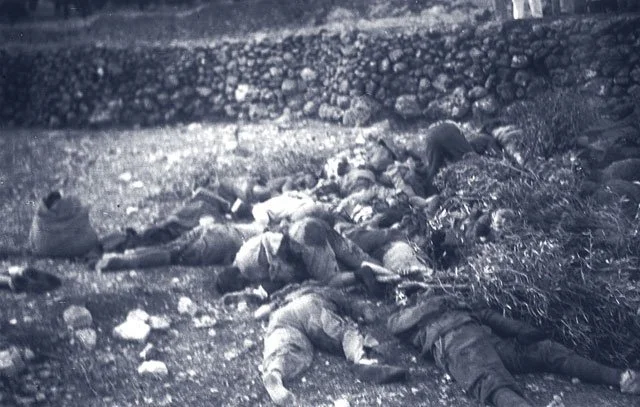
Murdered Italian prisoners, September 1943.
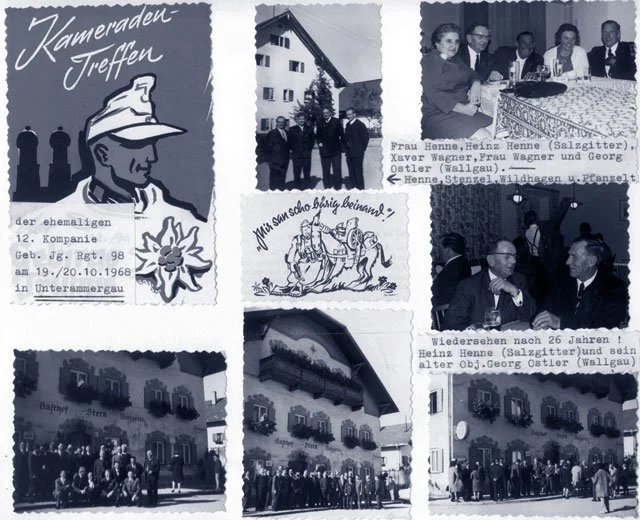
Since 1949, the veterans of 12./98 have held annual reunions.
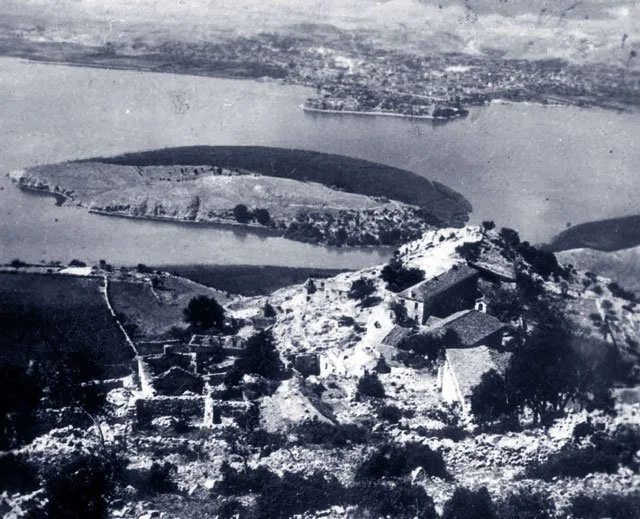
The village of Lyngiades was burned to the ground and more than 80 women and children were murdered in retaliation for the death of Regiment Commander Salminger in a partisan attack, 3 October 1943.
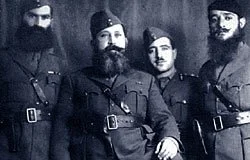
Colonel Napoleon Zervas (centre), commander of EDES, concluded a so-called ceasefire agreement with General Lanz, from autumn 1943 to summer 1944.
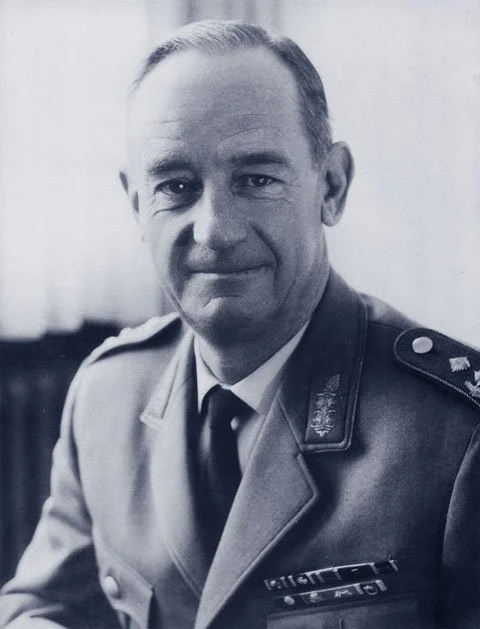
Karl Wilhelm Thilo, Ia (Chief of Operations) of the 1st Mountain Division of the Wehrmacht, later became a general in the 1st Mountain Division of the Bundeswehr.
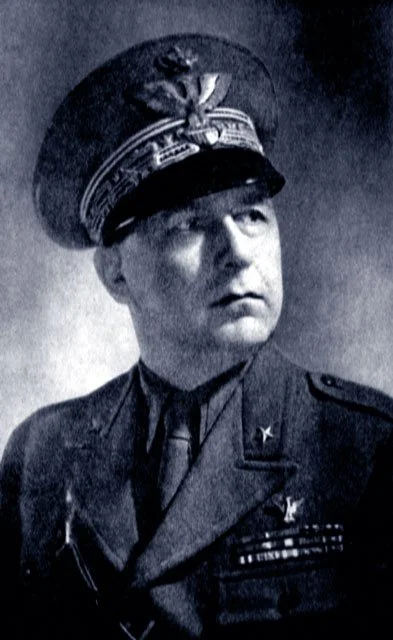
General Gandin was executed along with 130 other Italian officers on Kefalonia after the cessation of hostilities, September 1943.
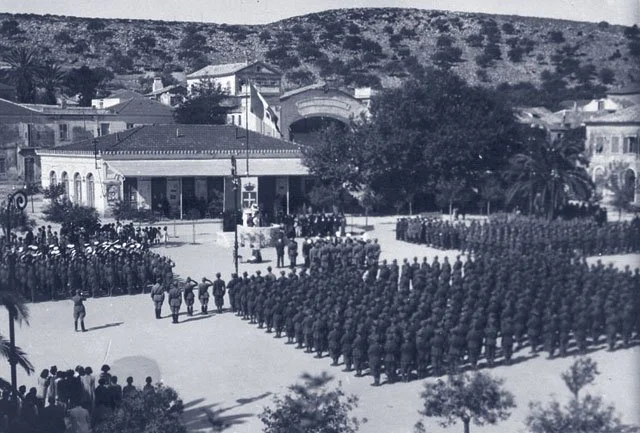
The Italian Acqui Division assembled for a parade in Argostoli, Kefalonia, September 1943.
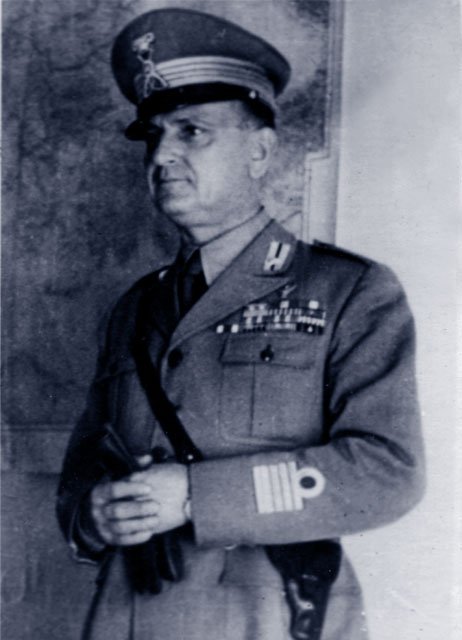
Colonel Luigi Lusignani, commander on Corfu, was executed after being taken prisoner, October 1943.
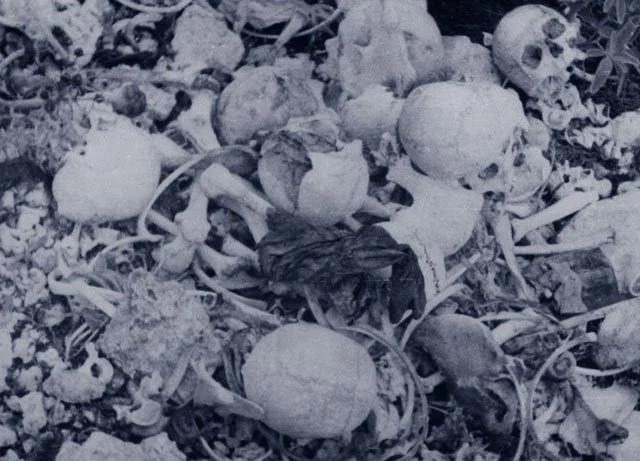
Years after the massacres on Kefalonia, the remains of hundreds of unburied victims were still being found, c. 1950.
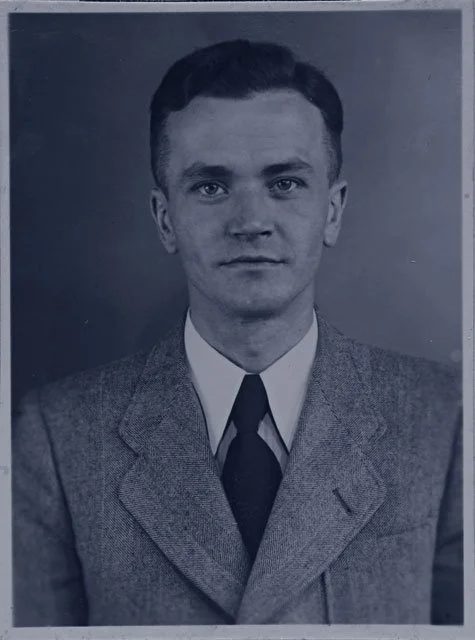
In cooperation with the XXII Mountain Army Corps, SS First Lieutenants Burger and Manowski ordered the deportation of the Jewish population of Corfu, July 1944.
Reviews:
Markus Mohr in Junge Welt, 30.09.2009
Horst Möller in Hellenika, 4/2009
Ralph Klein in Zeitschrift für Geschichtswissenschaften, 2/2009
Hans Heiss in Die Südtiroler Tageszeitung, 24./25.02.09
Kostas Kipuros in Leipziger Volkszeitung, 21.11.08
Dr. John Zimmermann in Militärgeschichtliche Zeitschrift (MGZ) 67 (2008)
Prof. Dr. Walter Manoschek, Österreichische Zeitschrift für Politikwissenschaften, 2009
Dr. Markus Mohr in W&F (Wissenschaft und Frieden), 4/2008
Hans Niedermayer in Bayern im Buch, 2/2008
Horst Möller in Die Brücke Sept. Dez. 08
Eberhard Rondholz in Blätter für deutsche und internationale Politik, Aug.08
Michael Martens in der FAZ, 16.8.08
Frank Brendle in ZivilCourage, Juli 2008
Lutz Maurer in Das Parlament, 2.8.08
Horst Möller in der Leipzigs Neue, 27.6.08
Dirk Walter in Münchner Merkur, 13.6.08
Dr. Bruno Thoss in der Frankfurter Allgemeinen Zeitung, 10.6.08
Eberhard Rondholz in Neue Rheinische Zeitung, 21.5.08
Dr. Markus Mohr in Junge Welt, 10.5.08
Eberhard Rondholz in Griechenland Zeitung, 7.5.08
Bundeswehr-General a. D. Winfried Vogel in Die Bundeswehr, April 2008
Kommentare dazu:
Oberst a. D. Manfred Benkel in Die Gebirgstruppe, 3, Juni 2008
General a. D. Gerd R. Meyer in Die Gebirgstruppe, 4, August 2008
Eberhard Rondholz am 31.3.08 im Deutschlandfunk (Text)
Eberhard Rondholz live am 31.3.08 im Deutschlandfunk (Audio)
H.-Georg Lützenkirchen in Literaturkritik.de Nr. 5, Mai 2008
Beitrag in Kulturzeit in 3SAT am 27. 2. 08 #
Beitrag in der ARD Sendung TTT, 10.2.08
Interview in Süddeutsche Zeitung 24.11.07
Jakob Knab Antifa Artikel 03/04 2008
Jutta Richter und Jörg Höhfeld in "Außerordentliche Schulung"
Von Wien nach Kalavryta. Die blutige Spur der 117. Jäger-Division durch Serbien und Griechenland
Σπυρος Μοσκοβου, Το Βημα, 20.07.08
O δημοσιογράφο K. Κουπαράνη στο Funkhaus Europa, 2.4.08
Minor Parliamentary Questions in the German Bundestag and Responses from the Federal Ministry of Defence
Kleine Anfrage im Deutschen Bundestag (Drucksache 16/8822), 11.04.2008
Antwort der Bundesregierung auf obige Kleine Anfrage (Drucksache 16/9033), 05.05.2008
Kleine Anfrage im Deutschen Bundestag (Drucksache 16/9585), 16.06.2008
Antwort des Bundesministeriums der Verteidigung (Drucksache 16/10026), 23.07.2008
Press Reviews
Sven Felix Kellerhoff in Die Welt, 7.5.08
Kaspar Dreidoppel Leserbrief an Die Welt, 9.5.08
Dr. Markus Mohr in Junge Welt, 10.5.08
Eberhard Rondholz in Neue Rheinische Zeitung, 21.5.08
Sven Felix Kellerhoff in Die Welt, 29.7.08
Frank Brendle in Junge Welt, 29.7.08
Eberhard Rondholz in Blätter für deutsche und internationale Politik, Aug.08
Dr. Markus Mohr in W&F (Wissenschaft und Frieden), 4/2008
Dr. John Zimmermann in Militärgeschichtliche Zeitschrift (MGZ) 67 (2008)