From Vienna to Kalavryta
The bloodstained trail of the 117th Jaeger-Division through Serbia and Greece
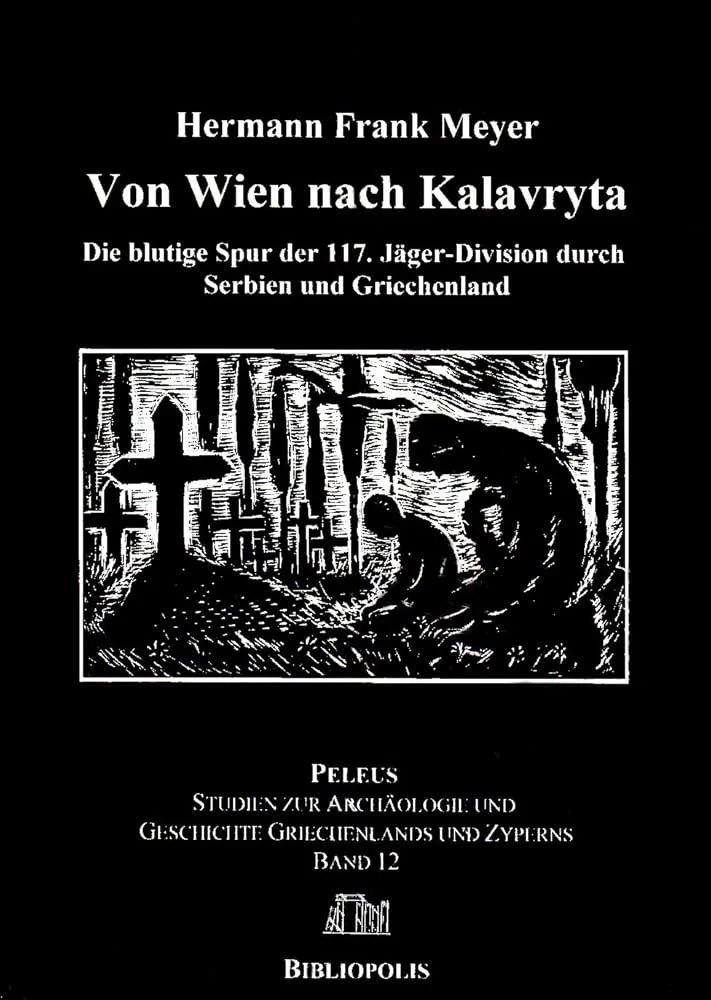
Von Wien nach Kalavryta
Die blutige Spur der 117. Jäger-Division durch Serbien und Griechenland
(Mannheim: Peleus, 2002)
Από τη Βιέννη στα Καλάβρυτα. Τα αιματηρά ίχνη της 117ης μεραρχίας καταδρομών στη Σερβία και την Ελλάδα
(Mannheim: Peleus, 2002)
www.hestia.gr
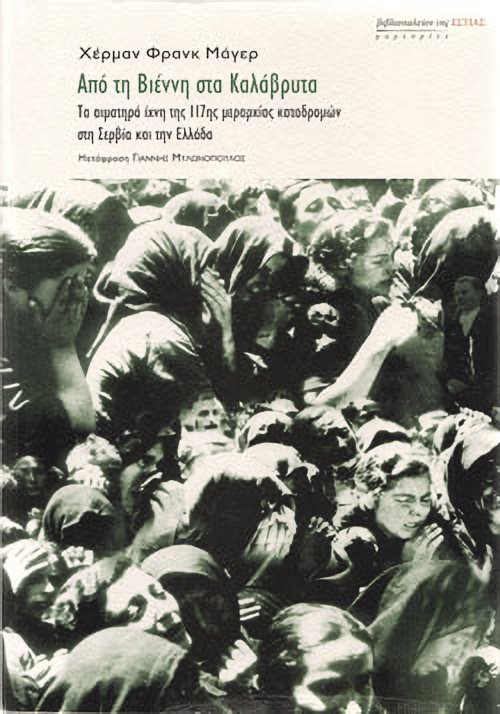
H. F. Meyer describes the course of the Second World War in the Peloponnese in his new comprehensive book full of pictures, plans and statistics.
Hitler never wanted to wage war in the Balkans, his main target being the Soviet Union, but he found himself sucked in, owing to Mussolini’s egomania and incompetence. After the occupation of Crete and the so-called black winter of 1941/42, when about 35,000 people died of famine in Athens, the Greek resistance movement flared up seriously.
The author follows the 717th Infantry Division that assembled older soldiers in Vienna and sent them into service in Serbia. This so-called Security Division was immediately involved in clashes with partisans. No prisoners were taken on either side. The writer divulges shocking documents showing the cold calculations used to determine the number of hostages to be shot. The order for reprisals, signed by Keitel, ruled that for every dead German 100 hostages were to be shot and for every wounded German fifty were to be shot. The division carried out the order mercilessly.
In spring 1943, the division was transferred to the Peloponnese to support the two Italian divisions stationed there. Hitler was afraid that "Fortress Europe" would be invaded there by the Allied troops massed in North Africa after Rommel’s desert corps had capitulated. When the division reached Greece, its name was changed to 117th Jäger-Division and it was rejuvenated, i.e. younger soldiers were trained in Thebes and replaced the older ones. They were led by Karl von Le Suire, general of the mountain troops, and Hellmuth Felmy, commander of LXVIII Army corps in Athens.
The author researched the lives of the two generals meticulously and shows how Felmy, who was basically a moderate, conciliatory man and Le Suire who was more uncompromising and ruthless, finally ordered the execution of hostages in order to cope with the growing force of resistance movements. The writer describes the role of the British who were parachuted into the peninsula to support and equip the freedom fighters with weapons. He follows the lives of the men who led the partisans and describes the immense suffering of the civilian population, who were always the ones to bear the brunt of the bloody clashes, no matter what the partisans, the British, Italians or Germans did.
British policy was very clumsy, however. By supporting the royalist faction of the resistance (ES), they turned the left-wing movement of the ELAS/EAM, infiltrated by the communist party of Greece (KKE), against themselves and each other. Terrible battles ensued, leading finally to the elimination of the ES by ELAS. Those fleeing from ES, who could not count on help from the British any more, ran straight into the arms of the Germans. They were used directly against their left-wing compatriots and grouped into so-called security battalions (Tagmata Asfaleias) at the end of 1943 and the beginning of 1944. The scene was set for civil war.
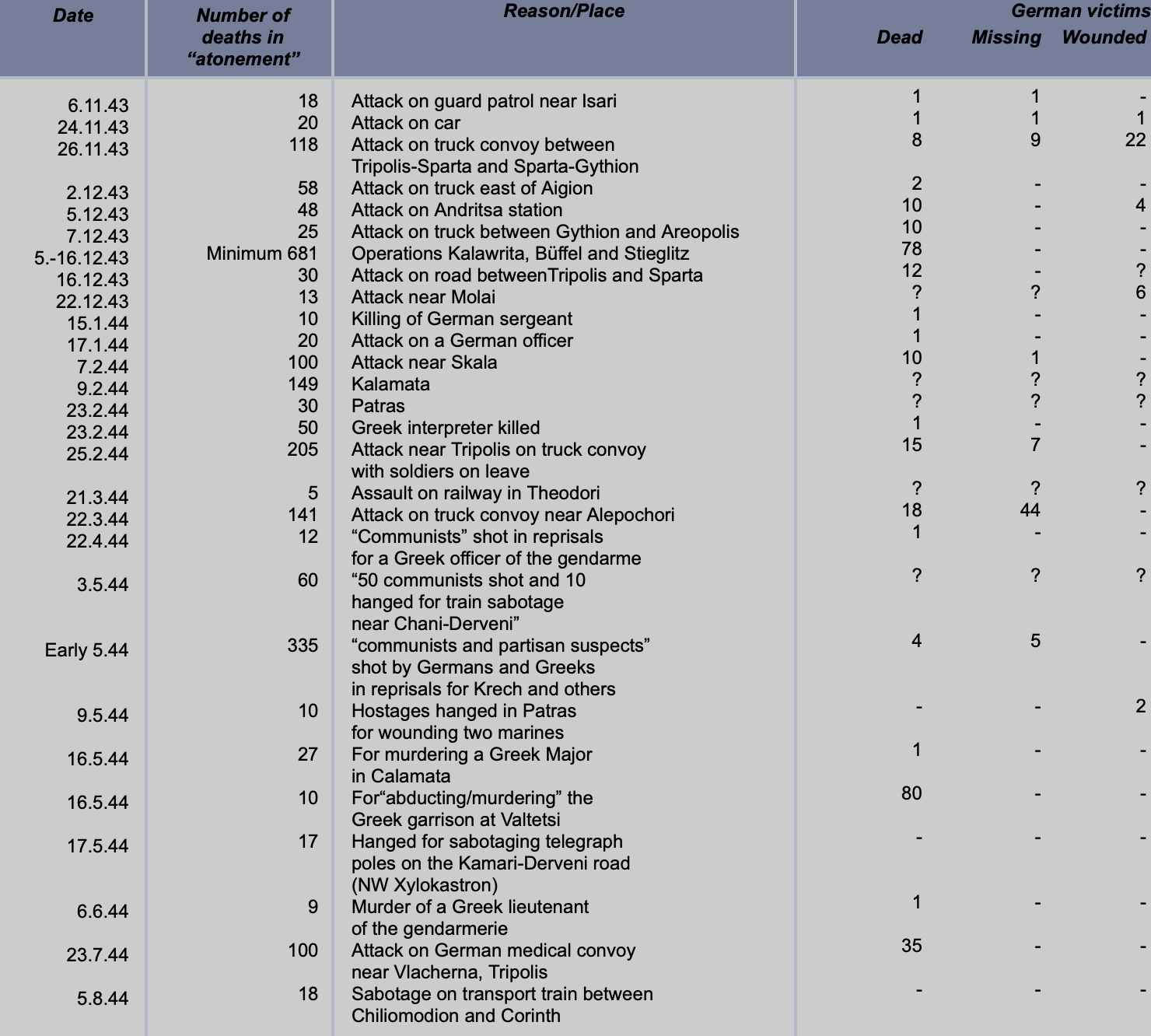
Meanwhile, the Italians capitulated in September 1943. The German troops were too thinly distributed over the peninsula to control their arms dumps so that large quantities of war material fell into the hands of the rebels who used them against the occupier. The Germans threatened to kill hostages but partisan attacks continued. In November 1943 the Germans shot the first hostages. Twenty-seven furtheratonement measures followed, called Sühnemaßnahmen. The security battalions often supported these. The author is able to reconstruct a complete picture of the horror by using eyewitness accounts, military documents and legal proceedings. In the time until the Germans retreated in the autumn of 1944, at least 2,319 hostages who were mostly innocent, paid with their lives for the death of at least 370 murdered Germans.
The main theme of the book concerns itself with “Operation Kalavryta”: Seventy-eight German soldiers were captured in October 1943 in a skirmish with freedom fighters whose leaders came from the township of Kalavryta.
Soon afterwards, three of the 78 Germans were murdered close to Kalavryta and the monastery of Aghia Larva (which was the birthplace of the freedom movement in 1821). Negotiations for an exchange of prisoners went on for weeks until Le Suire lost patience and ordered that the partisan strongholds should “be cleansed” with a view to freeing the captives. His express orders were that “the enemy is to be attacked forthwith and heavy weapons used to annihilate him” and that “every village using gunfire (…) should be burnt to the ground and all the men shot”.
The tactic failed because, confronted with the German advance, ELAS murdered their prisoners of whom two survided the execution. In addition, the Germans were unable to come to grips with their enemy as the partisans had melted away from the area around Achaia.
The author tells a terrible story of the events. He visited almost all the villages, consulted documents in more than two dozen libraries and archives and interviewed eyewitnesses in Germany, Greece, Austria, France and England. His research shows that at least 681 civilians were slaughtered. More than 50 villages and three monasteries were either totally or partly demolished. About 1,000 houses were burnt down and in most cases their contents pillaged. Over 2,000 sheep and larger animals were herded off to German encampments and about 260 million drachmas stolen in order - in military speak - “to deny the Greek civilians their life support systems”.
Countless books and reports have been written about “Operation Kalavryta” after the war. It is often rightly compared with Lidice and Oradour-sur-Glane. On the basis of the number of its dead, it has the unenviable attribute of being the biggest massacre perpetrated outside the Slavonic countries by the Wehrmacht in the Second World War. However, these reports are riddled with errors and untruth, giving rise to many different stories. The number of victims reported in these books and articles and even in legal proceedings increased dramatically over the years. For example, when the German Federal President Rau visited Kalavryta in 2000, he too, was influenced by these reports which state the total number of victims to be in the area of 1.400 dead. This is factually wrong. Exaggerations are not helpful in the search for the truth.
The author analysed the lists of victims’ names drawn up immediately after the massacre. He also visited all the villages involved and has been able to draw up the following detailed account:
Sites of shooting
Pagrati – 5 December (7 victims)
Lapanagous – 8 December (5 victims)
Planiterou – 8 December (4 victims)
Rogoi – 8 December (58 victims)
Kerpini – 8 December (37 victims)
Near Kerpini – 8 December (5 victims)
Ano Zachlorou – 8 December (8 victims)
Kato Zachlorou – 8 December (13 victims)
Mega Spilaion – 8 December (22 victims)
Majerou – 9 December (11 victims)
Kalavryta and Vrachni – 10, 13 & 14 December (487 victims)
Aghia Lavra – 14 December (5 victims)
Mazeika – 14 December (8 victims)
Psari, Asprokampos – 15 December (7 victims)
Out of the above total of 677, precisely 477 people were shot in Kalavryta on December 13th 1943. The Germans reported 696 executions, but the discrepancy can be explained: On the one hand, there were 15 survivors of Kalavryta and Rogoi and on the other hand fugitives were picked up and killed as the Germans carried out the operations. Le Suire was a stickler for exact reports from his officers, so that it may be assumed with confidence that the numbers given by his division are correct. Taking into account those who survived, the total number of civilians shot in the operation was at least 681.
H.F. Meyer studied case files of the Nuremberg trials and two other investigations conducted by the public prosecutors offices in Munich and Bochum after the war and he finds evidence to suggest that the competent public prosecutors were singularly dilatory. Legal proceedings were never initiated against the perpetrators because the prosecution deemed them to be untraceable. The author proves, however, that two of the main perpetrators were living in Austria at the time of the investigation. They were never called to justice till they died.
After “Operation Kalawrita” the battle against the resistance moved to the southern half of the Peloponnese. There were constant attacks with corresponding retaliation by the Germans. The brutal culmination was reached when the German General Krech and three companions were found dead. As a result Germans and collaborating Greek "Security Bataillons" (Tagmata Asfaleias) shot 335 hostages.
When the Germans retreated from the Peloponnese in October, they left behind a demolished infrastructure and a ravaged land. The only laudable exception was the seaport of Patras where the Swedish delegate of the International Red Cross, Hans Ehrenstrale, negotiated hard to ensure that the harbour installations remained intact.
Fate caught up with the 117th Jaeger-Division on its retreat through Yugoslavia. It lost more soldiers in two days in the battle for Belgrade than in the entire course of the war. The division withdrew to Austria in spring 1945 and fought against the invading Red Army and continued to fight a desperate rear guard battle for a day after the capitulation. The soldiers’ concern was to be taken prisoner by the American army rather than by the Russians. They achieved this. The Americans disarmed them and sent them home. The author’s research shows, however, that more than 6.000 members of the division lost their lives during the war.
The first German to visit Kalavryta after the war in 1952 was Ehrengard Schramm von Thadden, a historian and politician from Lower Saxony. After that, various reparations were paid, mostly privately, as described by the author. He also deals with the ongoing discussions about further payments being requested by Greece and victims and the fact that there has never been a peace treaty between the two countries.
The book has 560 pages and contains about 240 facsimiles and photos, many of which are unique. It can be obtained in bookshops or direct from www.rutzen-verlag.de
The author has collated some statistics showing that 28 so-called “atonement measures” were carried out in the Peloponnese between 6th November 1943 and 5th August 1944. He counted as one measure each the many executions during the operations "Kalawrita", "Büffel" and "Stieglitz" and the shooting of the hostages taken in retaliation for the death of General Krech and his companions. All in all, at least 2,319 Greek hostages were hanged or shot. They were killed in retaliation for 300 Germans who were murdered, 70 declared missing and 40 wounded.
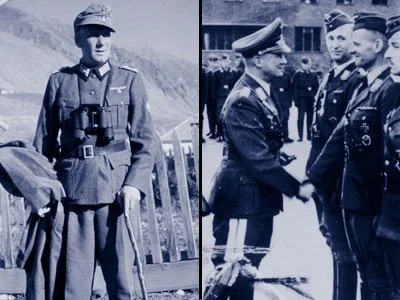
Die beiden deutschen Generäle Karl von Le Suire (links) und Hellmuth Felmy
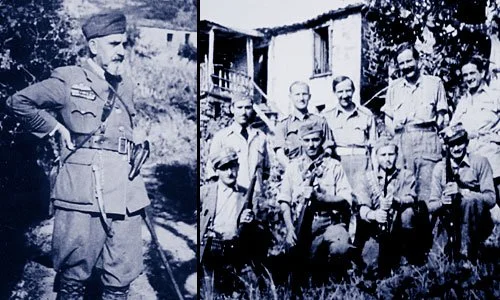
Der ELAS-Kapetanios Dimitrios Michos, ein ehemaliger Offizier der griechischen Luftwaffe, führte die Widerstandsbewegung im Raum Patras-Xylokastron-Tripolis. Sie wurde von britischen Verbindungsoffizieren unterstützt (hier mit ELAS-Andarten posierend), die per Fallschirm aus Nordafrika kommend über der Peloponnes abgesetzt wurden
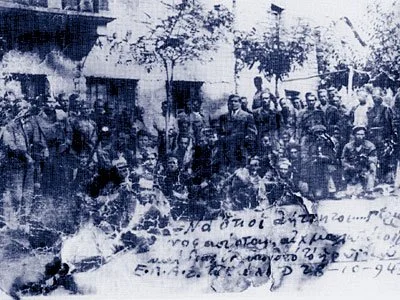
Die deutschen Angehörigen der 117. Jäger-Division am 28. Oktober 1943 in Gefangenschaft der Andarten
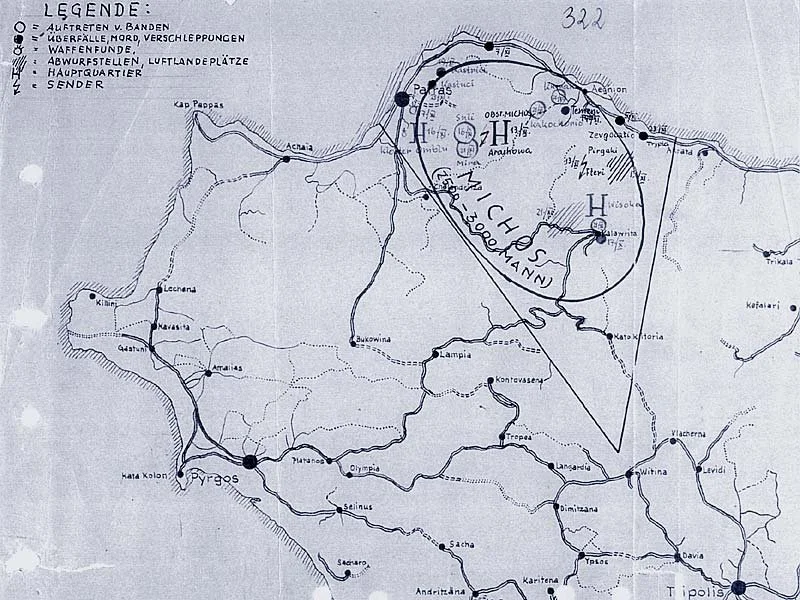
Die deutsche Abwehr hatte erkannt, daß Michos im Raum Patras-Xylokastron-Tripolis mit etwa 2.500 bis 3.000 Andarten agiert. Der Einsatzbefehl Le Suires ordnete die Zerschlagung dieser Verbände und die Befreiung der Gefangenen an. Als dies mißlang, befahl Le Suire: "Als sofortige Sühnemaßnahme Erschießung der männlichen Bevölkerung und Niederbrennen der Ortschaften"
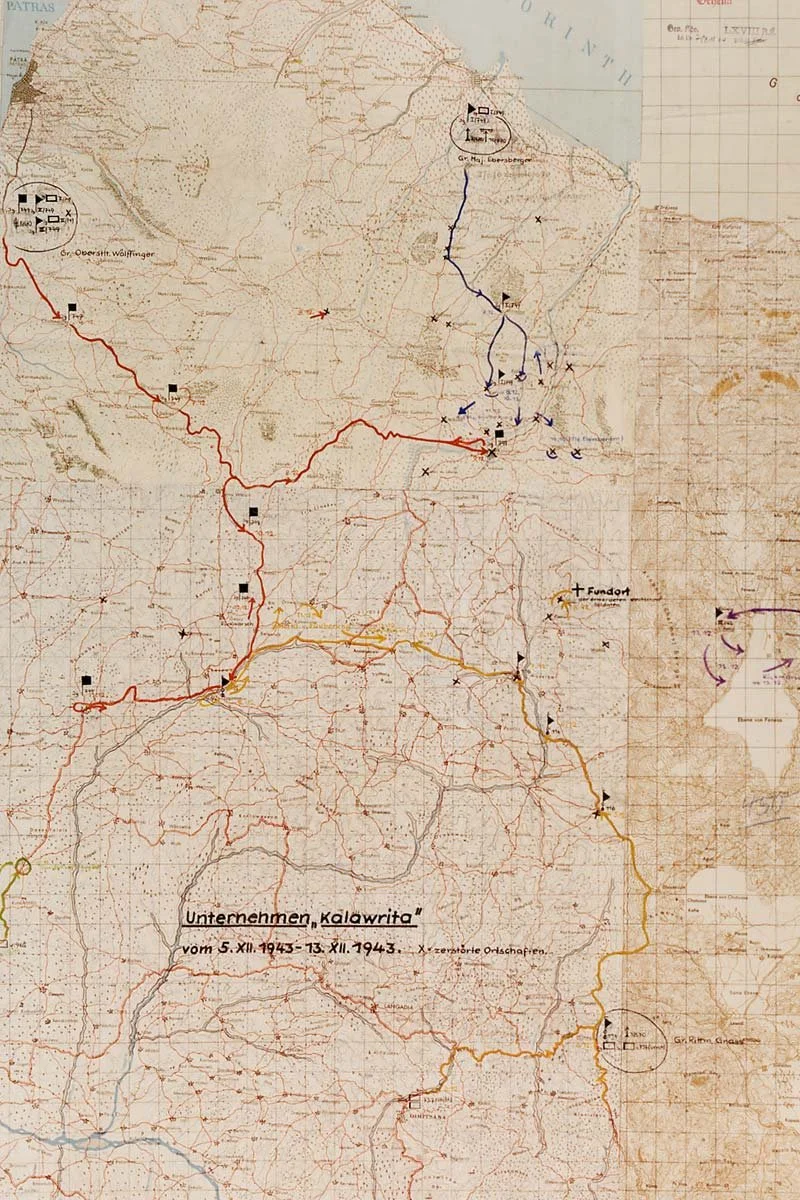
Eine Generalstabskarte über das "Unternehmen Kalawrita", das vom 5. bis zum 13. Dezember 1943 geführt wurde. In der Karte sind die Vormarschwege der Division auf Kalavryta eingetragen, einige der zerstörten Ortschaften und die Fundstelle der Leichen der ermordeten deutschen Gefangenen
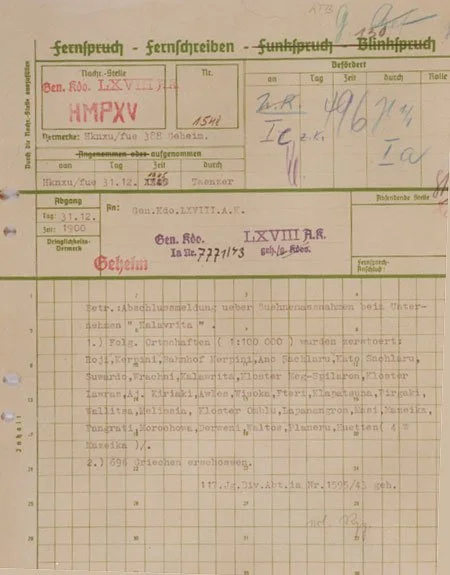
Laut dieser Meldung der 117. Jäger-Division vom 31. Dezember 1943 an das Generalkommando des LXVIII. Armee-Korps wurden während des "Unternehmens Kalawrita" 696 Personen erschossen
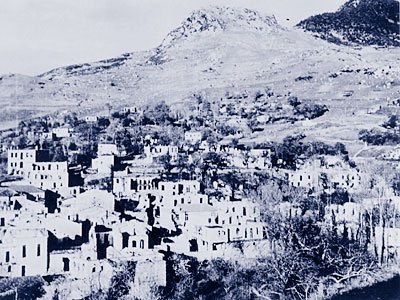
Die Kleinstadt Kalavryta nach der Zerstörung.
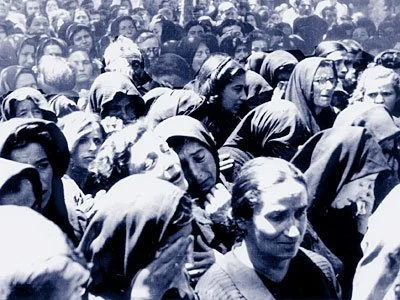
Trauer in Kalavryta, die "Stadt der Schwarzen Witwen"
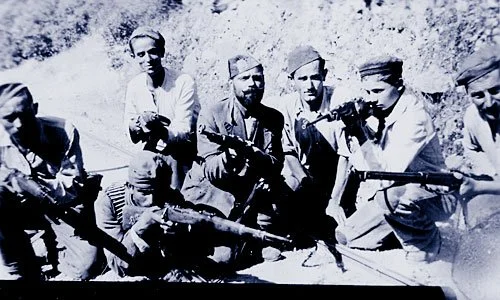
Hans Ehrenstrale fotografierte diese Andarten vor Kalavryta, als er die Kleinstadt im August 1944 besuchte.
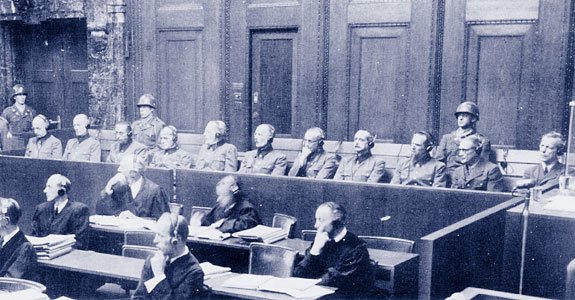
Während Karl von Le Suire 1954 in sowjetischer Kriegsgefangenschaft starb, wurde Hellmuth Felmy (zweiter von rechts) in Nürnberg zu 15 Jahren Gefängnis verurteilt. 1951 kam er jedoch im Zuge eines Amnestieverfahrens wieder frei
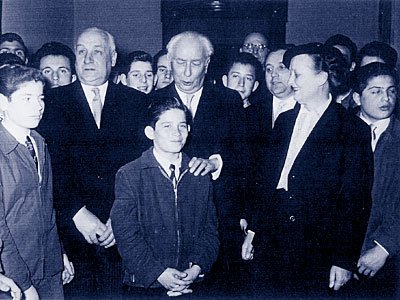
Ehrengard von Schramm ermöglichte 30 Waisenjungen aus Kalavryta eine Ausbildung in Deutschland. Das Foto zeigt sie mit den Jugendlichen bei einem Empfang bei Bundespräsident Theodor Heuß.
Reviews:
Bundespräsident Johannes Rau
(...) Ich finde es beeindruckend, mit welcher Sorgfalt Sie die Ereignisse im Umfeld des Massakers von Kalavryta und das Verbrechen in Kalavryta vom 13. Dezember 1943 recherchiert haben. Ihre detaillierte Dokumentation über die damaligen Ereignisse trägt auch dazu bei, dem Lesepublikum, Studenten und anderen Interessierten, die Möglichkeit zu eröffnen, sich auf der Grundlage von möglichst umfassenden Fakten mit dem damaligen Geschehnissen und Verbrechen auseinander zu setzen. (...) Die Kenntnis der Vergangenheit aber ist wichtig, um die Zukunft zu gestalten.
Horst Möller in „Leipzigs Neue“
Auf blutiger Spur in Griechenland
Der Verfasser (...) leistet bislang Unerhörtes, indem er entlegenste Dokumente ausfindig macht und alle Zeitzeugen, die er nur irgendwie erreichen kann, selbst wenn er sie in Neuseeland aufsuchen muss, befragt, um die Fakten zu ermitteln und sie zu sichern und um Täter aus ihrer Anonymität herauszuholen. Wenn er resümiert: „So fand die juristische Aufarbeitung des größten Massakers der deutschen Wehrmacht in Griechenland und eines der umfangreichsten überhaupt im Verlauf des Zweiten Weltkrieges ihren Abschluss mit eingestellten Ermittlungsverfahren: Nicht in einem einzigen Fall ist es vor deutschen Gerichten zu einer Prozesseröffnung gekommen - sicherlich kein Ruhmesblatt der deutschen Nachkriegsjustiz“, so ist das ganz gewiss nicht das letzte Wort in der Sache. (...) Unbedingt muss aber darauf bestanden werden, dass endlich eine Revision einstiger skandalöser Ermittlungsverfahren erfolgt und auf diese Weise ein Schuldeingeständnis nicht weiterhin verweigert wird. Die Besweislast des nun aufbereiteten Materials (auch das der beiden anderen Bücher H. F. Meyers: Vermißt in Griechenland und Kommeno) zwingt zu dieser Konsequenz. Denn der hier mit souveränem Urteilsvermögen, selten erlebtem Spürsinn und bewundernswertem persönlichen Einsatz Historiographie betreibt, ist keiner, der ohne das Erzürnen und Ereifern des Humanisten ans Werk geht (...).
Horst Möller in „Neues Deutschland“
Blutige Erde
(...) H. F. Meyer kennt seine antiken Klassiker, kennt Elektra, jene Figur, die sich sklavischer Unterdrückung erwehrte und im Verfolgen der gerechten Sache dann selbst wilderte. Griechische Partisanen haben den Vater des Autors (entgegen geltendem Kriegsrecht) erschossen, vor Ort befindliche Angehörige eines britischen Kommandounternehmens sind nicht dagegen eingeschritten. Dass H. F. Meyer sich nicht scheut, seinen Vater einen verblendeten Nazi zu bezeichnen, der Schuld auf sich geladen hat, beweist Größe. Und, dass er darauf beharrt, Verbrechen auch Verbrechen zu nennen und die zwischen Opfern und Tätern zu respektierende Trennlinie deutlich herauszustreichen.
Jakob Knab in „Antifa“
Griechenland im Zweiten Weltkrieg
Was in Griechenland während des Zweiten Weltkrieges geschah ist in Deutschland kaum bekannt. In dem hier vorgestellten Werk wird erstmals der Weg der 117. Jäger-Division von Ihrer Aufstellung 1941 bis zu ihrem Ende 1945 verfolgt und dabei in den gesamten Kriegsverlauf auf der Peloponnes eingebunden. Zentrales Thema sind die „Sühnemaßnahmen“ der Wehrmacht und das Massaker von Kalavryta. Autor Meyer zeichnet ein erschreckendes Bild dieser Gräueltat; er rekonstruiert minutiös die historischen Vorgänge, zeichnet die Lebensläufe der damaligen Täter und Opfer nach. Schließlich geht es um den Nürnberger Prozess gegen die „Südost-Generäle“ und das Versagen der deutschen Nachkriegsjustiz gegenüber den Tätern.
Gerhard Weber in „Gegen Vergessen - Für Demokratie“
Obwohl die Orte Distomo und Kalavryta in der griechischen Öffentlichkeit für Massaker der deutschen Militärs an der Zivilbevölkerung stehen und im kollektiven Gedächtnis der Griechen eingebrannt ist, standen bisher seriöse umfangreichere Untersuchungen der Vorfälle weitgehend aus. Eine dieser Lücken schließt die nunmehr vorliegenden Studie von Hermann Frank Meyer, in der er die Vorgänge, in die das Massaker von Kalavryta eingebettet ist, lückenlos aufgearbeitet hat.
Das Buch von H. F. Meyer zeigt die Realität der deutschen Besatzungspolitik während des Zweiten Weltkrieges in Griechenland. Er zeichnet in seiner äußerst exakt recherchierten, wissenschaftlich fundierten und spannend zu lesenden Studie die Einsätze der Division zunächst nach Serbien und dann ab Anfang 1943 auf der Peloponnes nach. (...) Der Verfasser hat beeindruckendes Fotomaterial erschlossen. Im Anhang befindet sich im farbigen Fakisimiledruck eine Einsatzkarte der Wehrmacht zu den militärischen Operationen, die zum Massaker von Kalavryta führten.
Das Buch von H. F. Meyer schließt eine Lücke in der Erforschung der deutschen Besatzungszeit während des Zweiten Weltkrieges in Griechenland.
Weste Westesson in „Hellenika“, Sweden (...)
To get an idea of Meyers research it suffices to take a look at the literature references and his listing of sources. He has consulted British, German, Greek and Austrian archives as well as the International Red Cross in Geneva and all relevant court reports. He has gone through several hundred printed books and studies, memoirs, and biographies, diaries and personal histories. And he has tracked down and interviewed survivors, both amongst the Greeks and the Wehrmacht. At the same time as he is researcher, his accounts of events involves him deeply, the most important episodes made vivid by quotes from eywittnesses, which gives the intensive feeling of being contemporary, almost present.
Meyer is a very skilled writer who makes full use of the dramatic potential of the subject. In spite of the size of the work of 550 large pages of which some 70 belong to the important annexes the text is never heavy or difficult. This is further enhanced by the authors frequent digressions made possible by his masterly grasp of his subject with all its rich details and the many miniportraits he has drawn of involved persons...
Review by Nikola Zivkoviç in South Slav Journal, Vol, 24,No. 3-4, 2003
Στάθης Ν. Καλύβας, Οι κυνγοί και οι αντάρτες ΤΟ ΒΗΜΑ, 15.2.2004