Bridges, too, have a destiny
Auch Brücken haben ihr Schicksal
Zerstörung und Wiederaufbau der Asopos-Brücke in Griechenland im Sommer l943", in Thetis,
Mannheimer Beiträge zur Klassischen Archäologie und Geschichte Griechenlands und Zyperns,
4 (Mannheim, 1997).
Auch Brücken haben ihr Schicksal
Zerstörung und Wiederaufbau der Asopos-Brücke - Griechenland im Sommer l943
a. Operation "Washing"
b. Die Sprengung des Kournovon-Nezeros Tunnels im Rahmen der Operationen "Animals" und "Washing"
c. The job's in the bag
d. Hitlers Reaktionen und Churchills fröhliches Kichern
After the capitulation of the Africa corps on May 13th 1943, Hitler became increasingly worried about the southern flank of “fortress Europe”. He was led to expect an allied landing in southeast Europe because of an ingenious diversionary tactic called “Operation Mincemeat”. To further this expectation, SOE Cairo ordered the chief of the British Military Mission to the andartes, Eddie Myers, to carry out “Operation Animals” to divert attention from the intended allied landing in Sicily.
EDES and ELAS partisan bands under the leadership of British liaison officers made dozens of attacks in June and July 1943. The trick worked. Believing that an invasion of either the Peloponnese or Epirus was imminent, Hitler transferred an additional 70,000 men to support the Italian divisions stationed there. "Operation Animals" started like a thunderbolt: Near Kozani in Thessalia on June 21st ELAS bands surprised and destroyed a German company bringing 82 heavy goods vehicles from Bulgaria to the Peleponnese. Ninety-nine Germans were killed; most of whom were murdered after their capture.
On the same day four members of the Commonwealth army blew up the Asopos bridge which towered 80 metres over the mountain river spanning its hundred-metre length in one arch. This bridge lay only a few kilometres south of the railway viaduct over the Gorgopotamos.
The bridge could only be approached through tunnels on either side of the ravine in otherwise almost inaccessible terrain. The ELAS leaders (Andreas Tzimas, Aris Velouchiotis and Stefanos Sarafis) refused to collaborate as they judged the undertaking to be too dangerous. Losses would be too high, particularly because the Germans had fifty men stationed there to guard the bridge. The British commandos, flown in from North Africa for this mission, managed to work their laborious way up the mountain river to a position underneath the bridge. Finding that they needed additional ropes to brave the torrential rapids they had to return to base camp. It took four weeks before Cairo headquarters was able to drop in further rope.
Meanwhile Sarafis took responsibility for blowing up the 510-metre long northern railway tunnel near Kournovo (today’s Nezeros). The British supplied the necessary explosives. Spiros Bekios (alias “Lambros”) an andarte with ELAS, pushed the button successfully on June 1st, but according to a report by the Wehrmacht, a train was in the tunnel carrying soldiers on leave. “200 to 300 Italians and 7 Germans” died in the ensuing inferno. Two days later, Italian troops shot 118 hostages at the tunnel entrance in retaliation. From a military point of view, the attack on the tunnel was pointless because it was in use again within two days owing to the explosives having been placed inexpertly.
When the allied commandos returned and successfully demolished the Asopos bridge on June 21st, no Greeks took part. This might in part explain why hardly anyone in Greece knows about this spectacular operation, which is considered to be among the most gallant achievements of sabotage in the Second World War. Over one thousand specialised German Railway Engineers worked around the clock to repair the bridge. Then a segment of the bridge collapsed, killing 40 German and Greek workmen. When the viaduct was operational again on August 27th 1943, the German engineers had achieved a truly outstanding performance by prefabricating the segments and joining them from the tunnel mouths at either side of the bridge. Meanwhile a backlog of hundreds of tons of war materials and provisions destined for the German troops in the Peloponnese was building up to the north of Lamia. The Allies failed to use their advantage. Without heavy goods vehicles nor heavy weaponry, the badly equipped Germans would have been in no position to fend off an invasion.
The destruction and reconstruction of the Asopos bridge are described in detail in an essay entitled Auch Brücken haben ihr Schicksal published in the specialist journal Thetis. It can be obtained through: www.rutzen-verlag.de .
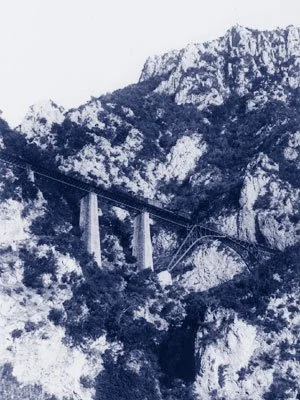
The three-hinged arch bridge over the Asopos mountain stream before its demolition.
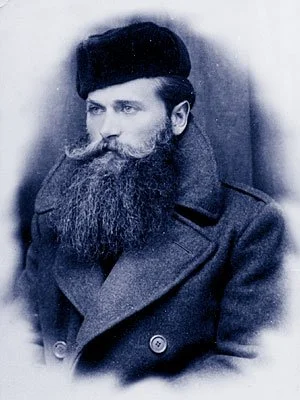
ELAS resistance fighter Spyros Bekios, whose nom de guerre was "Lambros", placed the explosive charges inside the Kournovo Tunnel. More than 200 Italian and German military personnel were killed in the attack. In reprisal, Italian troops executed 118 Greek hostages in front of the tunnel entrance.
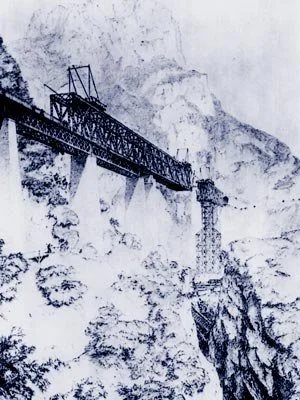
More than 1,000 highly specialised German military engineers rebuilt the Asopos Bridge. When the German forces withdrew from Greece in October 1944, they blew it up once again.
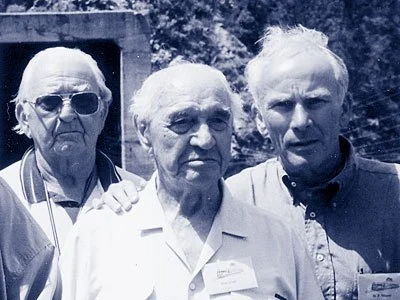
At the invitation of the Association of the Friends of the Greek Railways, the author (right) visited the Asopos Bridge in May 2001 with Ken Scott (centre), who had blown it up, and Adolf Brennecke, who had rebuilt it.
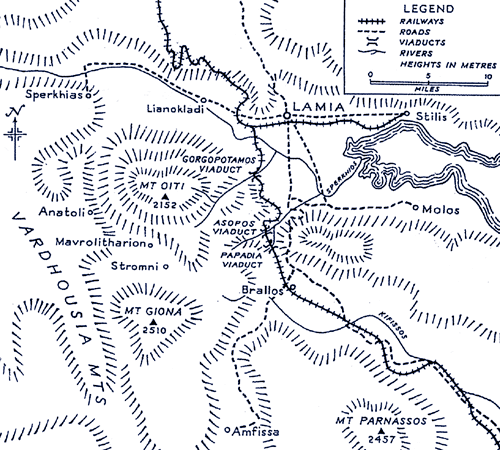
The operational area with the Gorgopotamos and Asopos railway bridges.
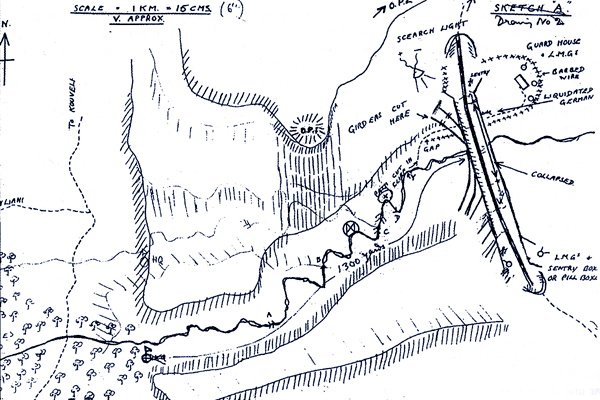
Drawing from Faith's (Geoffrey Gordon-Creed's) "Washing Log", 25 June 1943.
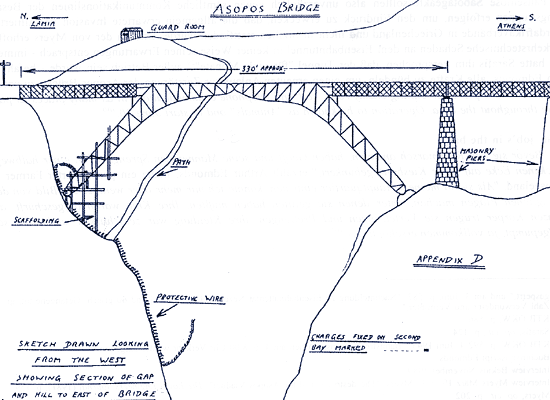
This sketch was prepared by Ken Scott ("Kilt") as part of his report to E. C. W. Myers ("Eddie")
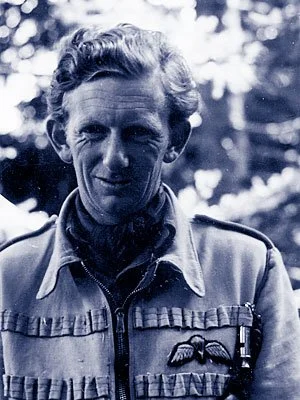
The New Zealander Don Stott ("Weasel") led the daring assault on the Asopos bridge. Its destruction made Hitler believe that the invasion of Greece was imminent. As a consequence he ordered additional 70,000 German troops to be moved to Greece.
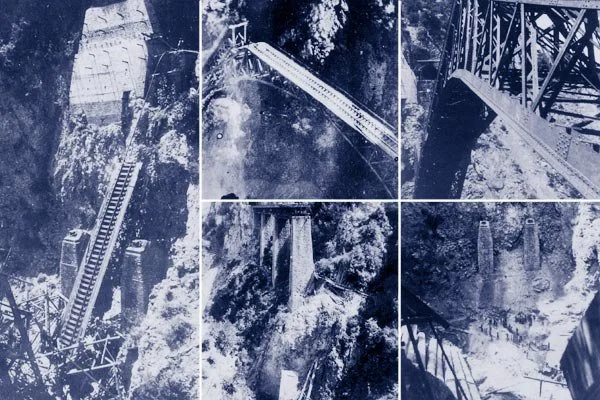
The bridge under reconstruction in July 1943.
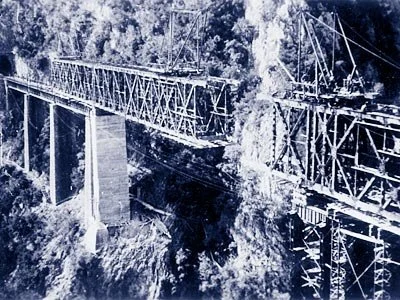
The bridge during reconstruction, shortly before it collapsed again because of failing rams
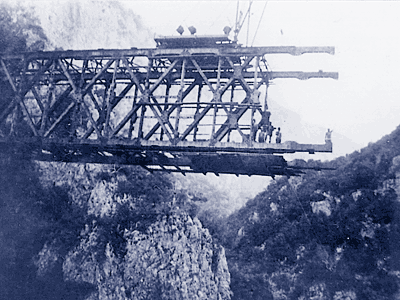
A German soldier 80 meters above the Asopos-river, without harness, but with the so-called Hitler-Nazi-salute
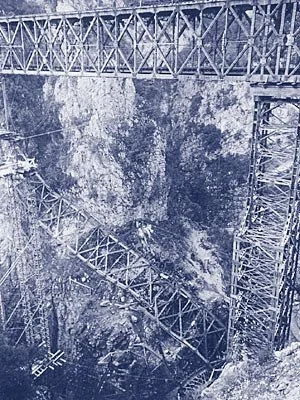
The new RW bridge and the RW piers; wreckage of the collapsed bridge sections.
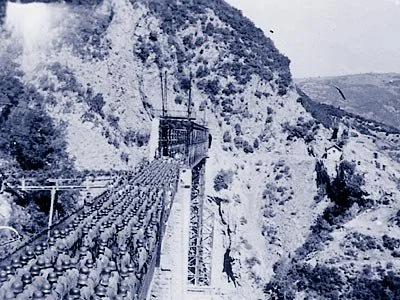
Reopening ceremony of the bridge on 27 August 1943.
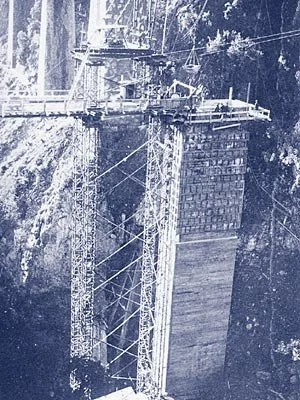
The rising pier on 6 March 1944.